Iowa Back InstituteLed by Andrew J. Pugely · MD, MHCDS 563-421-4370
Research & academic leadership

Nationally recognized research. Applied to every patient.

Nationally recognized research · evidence-driven decisions · personalized spine care

Dr. Andrew J. Pugely is a nationally recognized orthopaedic spine surgeon, researcher, and physician leader whose work has helped advance the understanding of spine surgery outcomes, complications, healthcare quality, value, and patient safety. He has authored more than 110 peer-reviewed scientific publications, and his research has been cited thousands of times throughout the medical literature.

110+
Peer-reviewed scientific publications
7,000+
Academic citations across broad research databases
44–48
Approximate h-index, depending on citation database
Top few %
Estimated research impact among academic orthopaedic and spine surgeons, per published bibliometric comparisons
Citation totals and h-index values vary by academic indexing platform and continue to increase over time.
The scholarship

A national research record, built case by case.

Dr. Pugely's work has accumulated more than 5,700 citations in conservative academic indexing systems and more than 7,000 citations across broader research databases. Depending on the citation platform used, his h-index is approximately 44 to 48 — reflecting a sustained record of influential scholarship. Because Google Scholar, Scopus, Web of Science, and other databases index the literature differently, publication totals and citation counts vary among platforms.

Published bibliometric comparisons suggest that this level of academic productivity and citation impact places him among approximately the top few percent of academic orthopaedic surgeons and academic orthopaedic spine surgeons. There is no single official national ranking system; these figures are evidence-based estimates, not formal percentile designations.

His research has addressed some of the most important questions in modern spine and orthopaedic care: Which patients benefit most from surgery? What factors increase the risk of complications? How can hospitals improve quality and safety? How should physicians evaluate cost, value, readmissions, recovery, and long-term outcomes? How can large clinical databases be used to improve decisions for individual patients?

Dr. Pugely developed this body of scholarship during an active clinical and academic career — achieving a citation profile more commonly associated with senior academic faculty and long-established investigators.
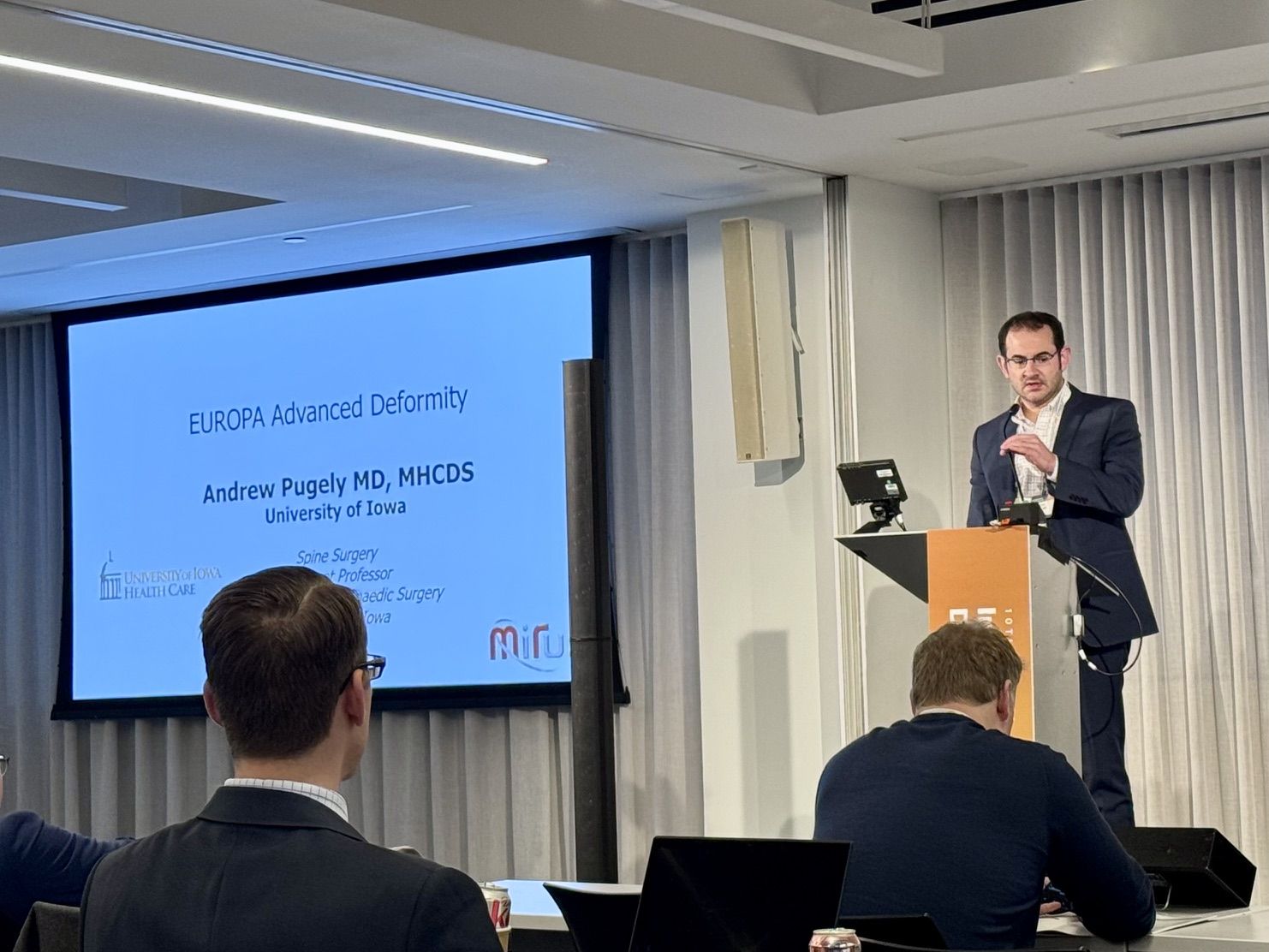
Dr. Andrew Pugely presenting advanced spinal deformity research from the podium at an academic meeting
Presenting advanced deformity research at a national academic meeting — the scholarship carried straight from the lectern into the operating room.
Research focus

Ten questions, studied for a decade.

Spine surgery outcomes
Adult spinal deformity
Surgical complications
Risk prediction
Patient safety
Healthcare quality
Value-based care
National database research
Healthcare utilization
Service-line strategy
Why this matters to you

Research is not separate from your care.

It shapes how Dr. Pugely evaluates risk, selects surgical strategies, discusses expected outcomes, and works to improve safety throughout your episode of care.

For patients

This academic background means recommendations are grounded in evidence, measurable outcomes, and a detailed understanding of surgical risk — the goal is the right treatment for the right patient, not an operation simply because one is technically possible.

  • Whether surgery is truly necessary — and when it isn't
  • Which operation offers the best balance of benefit and risk for you
  • How to reduce complications and improve your recovery
  • Honest counseling — expectations set by data, not hope
  • New technology, evaluated — adopted when the evidence supports it

From research to health-system leadership

The same analytical approach used in academic research informs Dr. Pugely's leadership of orthopaedic care: designing care pathways, measuring quality, aligning practice with evidence, and using resources responsibly.

  • Integrated orthopaedic systems built on outcomes data
  • Consistent quality across surgeons, APPs, hospitals, and rehab teams
  • Value over volume — efficient pathways that reduce unnecessary delay
  • Evidence translated into everyday operational improvement
Selected research & publications

Six studies, and what each one changed.

Representative work from a publication record of 110+ peer-reviewed studies — each linked to its National Library of Medicine record.

Outpatient safety & value
Outpatient Surgery Reduces Short-Term Complications in Lumbar Discectomy: An Analysis of 4,310 Patients from the ACS-NSQIP Database
Pugely AJ, Martin CT, Gao Y, Mendoza SA · Spine · 2013
Helped establish the safety of outpatient spine surgery — the model now offered at the region's certified surgery centers.
PubMed →
Risk prediction
A Risk Calculator for Short-Term Morbidity and Mortality Following Hip Fracture Surgery
Pugely AJ, Martin CT, Gao Y, Callaghan JJ, Marsh JL · Journal of Orthopaedic Trauma · 2014
Turning national data into a bedside tool — predicting an individual patient's risk before the operation.
PubMed →
Readmissions & utilization
Incidence and Risk Factors for 30-Day Readmission Following Elective Primary Joint Arthroplasty
Pugely AJ, Callaghan JJ, Martin CT, Cram P, Gao Y · Journal of Arthroplasty · 2013
Identifying why patients return to the hospital — so care pathways can be designed to keep them home.
PubMed →
Cost & value
Preparing for Bundled Payments in Cervical Spine Surgery: Do We Understand the Influence of Patient, Hospital, and Procedural Factors on Cost and Length of Stay?
Kalakoti P, Gao Y, Hendrickson NR, Pugely AJ · Spine · 2019
Mapping what actually drives the cost of spine care — the groundwork of value-based surgery.
PubMed →
Patient safety — modifiable risk
The Impact of Current Smoking and of Recent Smoking Cessation on Short-Term Morbidity Risk After Lumbar Spine Surgery
Martin CT, Gao Y, Duchman KR, Pugely AJ · Spine · 2016
The evidence behind the practice's non-negotiable smoking-cessation counseling before fusion surgery.
PubMed →
Deformity & complications
Causes and Risk Factors for 30-Day Unplanned Readmissions After Pediatric Spinal Deformity Surgery
Martin CT, Pugely AJ, Gao Y, Weinstein SL · Spine · 2015
Understanding complications in the most complex reconstructions — knowledge carried into every adult deformity case.
PubMed →
Publication counts, citation totals, and h-index values vary among academic databases (Google Scholar, Scopus, Web of Science, and others) and change over time. Percentile estimates are based on published bibliometric comparisons of academic orthopaedic and spine surgery faculty and do not represent an official national ranking.
The point of all of it

National academic experience matters most when it improves the decision made for one patient.

After more than a decade in academic medicine, Dr. Pugely brings nationally informed, research-driven spine care to MercyOne Genesis and the Quad Cities. His research, clinical experience, and leadership are united by a single goal: safer, more effective, and more thoughtful spine care — advanced surgical expertise with careful patient selection, honest communication, and measurable outcomes.

Put the evidence to work on your case

Request an appointment — or refer a patient.

563-421-4370