Modern spine surgery is guided by robotics, navigation, and materials that didn't exist a decade ago. This practice operates with the technology built by the most trusted names in the field — and is among the earliest in the country to bring home the newest robot of them all.
FDA-cleared in February 2026 and used in the world's first case only weeks ago, the Stealth AXiS is the newest robotic-navigation platform in spine surgery. This practice is among the first in the country to bring it into the operating room.
A first-of-its-kind system that detects the patient's spine moving during surgery and adjusts the plan instantly — solving one of the oldest challenges in the operating room.
Artificial intelligence supports the placement of each screw against the patient's own imaging — planned before the incision, verified during the operation.
By tracking anatomy in real time, the system is designed to reduce errors and cut the radiation exposure a traditional procedure would require.
“One of the biggest challenges in spine surgery has been understanding how the patient's spine moves during the procedure. This gives the ability to see it instantly and adjust the plan.”
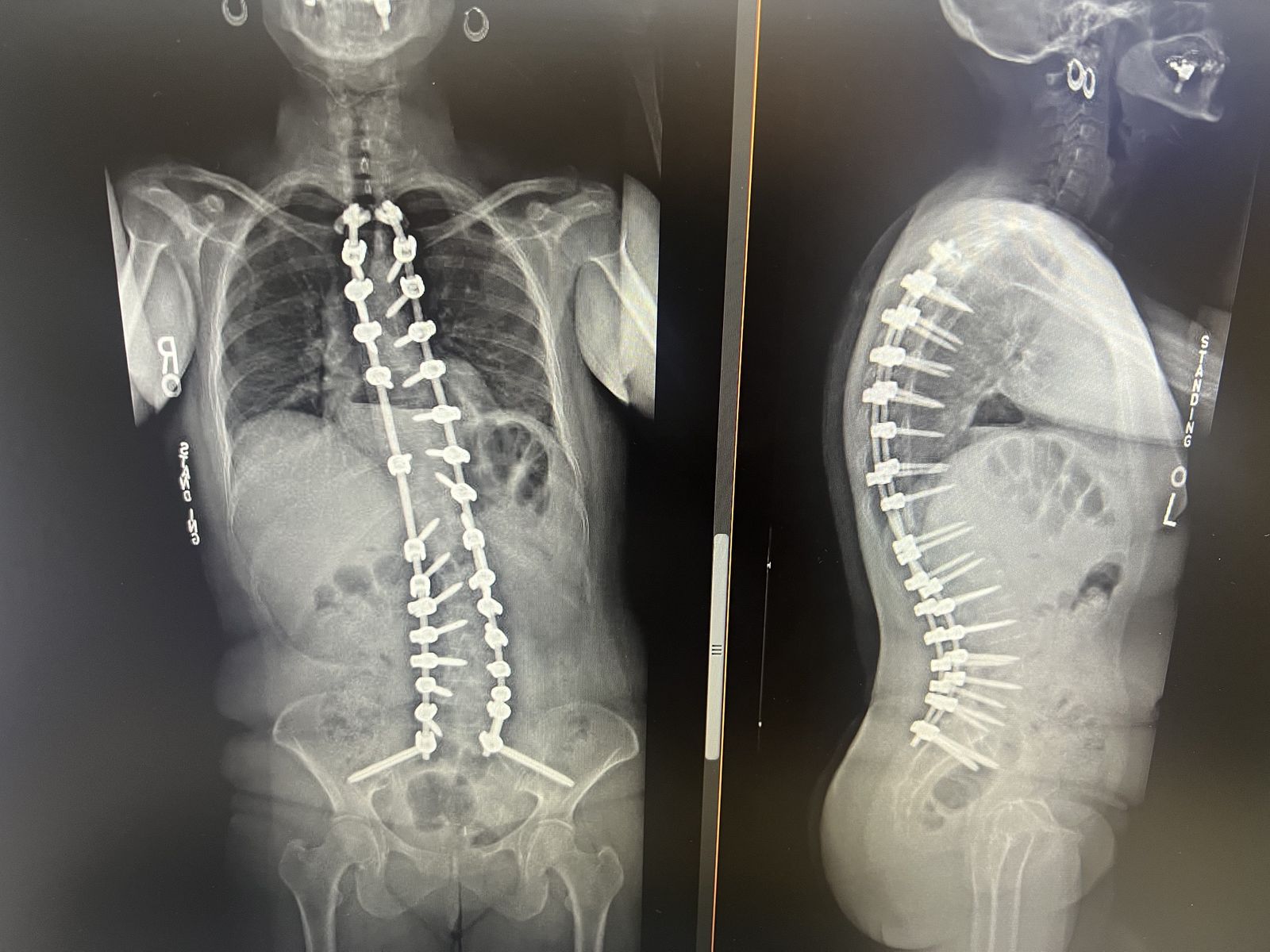
Robotic spine surgery isn't a machine operating on its own. It's a precision guidance system — the surgeon plans every screw on the patient's own imaging, and the robot holds the exact trajectory while Dr. Pugely does the work.
Your CT and MRI become a 3-D model of your spine. Every screw's size, angle, and depth is chosen in advance — on your imaging, not a generic template.
At surgery, the navigation system matches the live position of your spine to that plan, accurate to the millimeter, and tracks it continuously.
The robotic arm locks onto each planned path and holds it rock-steady, so the instrument goes exactly where the plan intended.
Dr. Pugely performs every step. The robot guides; the surgeon decides, places, and controls — start to finish.
Three companies, each a leader in its lane — the market-defining giant, the robotics disruptor, and the materials innovator rewriting what an implant can be.

Medtronic is the largest medical device company in the world by revenue and the market leader in spine. Its history is a list of world-firsts — from the first wearable pacemaker to the world's smallest — and in spine, its robotic-navigation platforms set the standard the field measures against.

Globus is the second-largest spine company in the world and the company that forced the entire field to take robotics seriously. Its ExcelsiusGPS® robot pairs rigid navigation with a robotic arm for screw placement, and after merging with NuVasive it now spans everything from lateral access to neuromonitoring.

MiRus makes what may be the most advanced implant material in spine: MoRe®, a molybdenum-rhenium superalloy inspired by the metallurgy of rocket engines. It's the first genuinely new implant alloy the FDA has cleared in nearly four decades — 2–3× stronger and more fatigue-resistant than titanium, so implants can be smaller and less invasive without giving up strength.
The hardware that holds your spine while it heals is chosen for your specific anatomy. Newer materials let that hardware do more with less.
A stronger alloy means the same fixation can be achieved with a thinner rod or a lower-profile plate — which means less disruption to the muscle and tissue around your spine.
Spinal hardware flexes with every movement for the rest of your life. More fatigue-resistant metal is built to endure that cycle — MiRus is confident enough to warranty its rods for life.
Implants that release fewer metal ions into surrounding tissue are gentler on the body — an increasing priority for both surgeons and patients.
A robot doesn't make a surgeon. Experience, judgment, and volume do. What the best technology does is take a surgeon who already knows exactly what the spine needs and let them execute it with a precision the human hand alone can't match.
“The robot holds the trajectory. I still make every decision, place every implant, and own every outcome. The technology just makes my plan more exact.”
